Kilosend
Email API pricing page template · Software and web
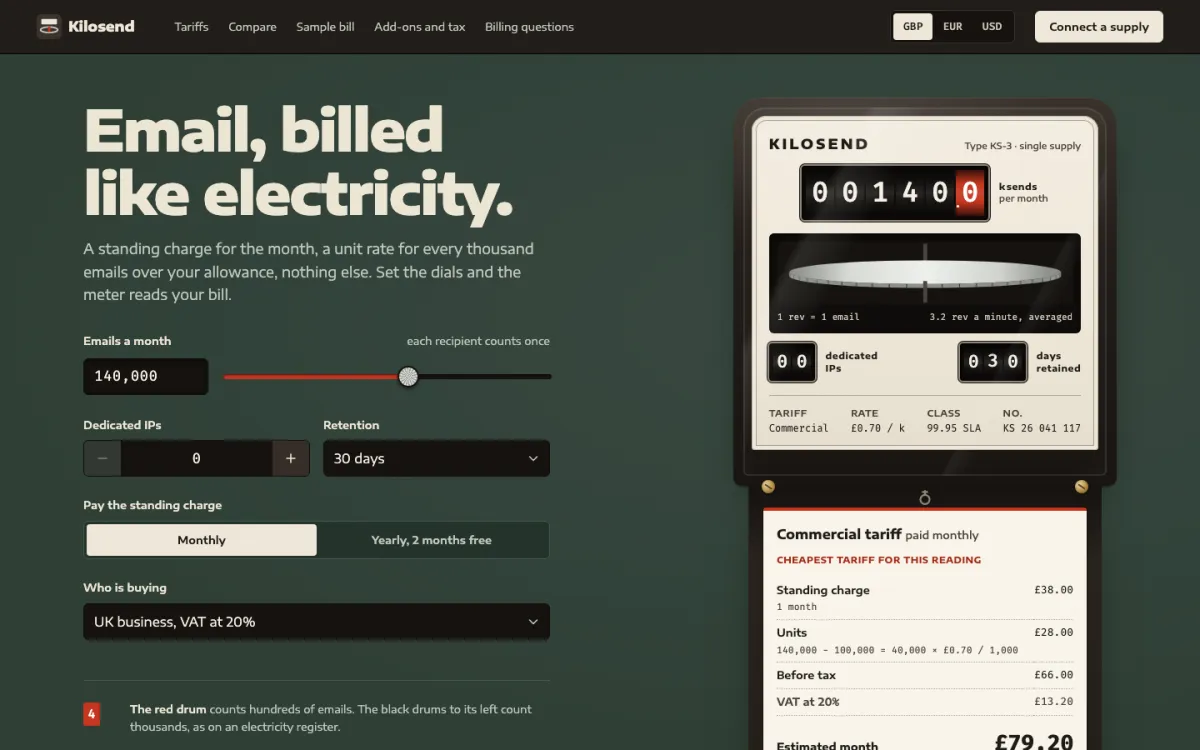
A utility meter cupboard: a painted green meter board, a bakelite electricity meter under a glass cover with an enamel nameplate, rolling register drums with the red tenths drum, an aluminium disc seen edge-on, a lead seal, and cream tariff paper for everything below.
The first screen is the meter. Type a monthly email volume or drag the knurled slider, set dedicated IPs and how many days of message history to keep, and the register drums roll to the new reading in thousands, the red drum counting hundreds. The aluminium disc behind its slot turns faster as the volume rises, and the tariff card slotted under the dial writes out the bill line by line: standing charge, units over the allowance with the subtraction and the rate shown, IPs, extra history in 30-day blocks, VAT and the total.
The card always names the cheapest tariff that can carry the reading and prices the same reading on the other two, so the recommendation can be checked. It warns when a dedicated IP is bought below the volume that keeps one healthy, when the reading nears a tariff's ceiling, and when nothing carries it, in which case it switches to a high-voltage quote and shows the Industrial arithmetic as the most a quote could cost. A monthly or yearly switch (twelve months for ten) and a GBP, EUR and USD switch with stated fixed rates reprice every number on the page.
Below the meter come the three tariffs with real limits and the reason Commercial is marked, a full comparison that shows one tariff at a time on phones, a sample bill read like a gas bill from two register readings, the schedule of add-on charges with currency, tax and spending-cap rules, and billing questions on proration, refunds, cancelling, invoices and charity discounts. Connect a supply is the checkout: it prorates the standing charge to the end of November, applies VAT by billing country and reverse charge for a valid EU VAT number, validates inline and has loading, error and success states.
The brand is fictional: Kilosend, a transactional email API in Leeds that bills like a utility: a standing charge per month and a unit rate per thousand emails. Names, people and figures on the page are invented.
What works
- Emails a month: typed (accepts 140000, 140k, 1.4m) or a logarithmic slider from 1,000 to 6,000,000; specific errors for unreadable or out-of-range input
- Dedicated IP stepper and retention select; IPs over any tariff's limit explain the high-voltage route
- Register drums roll to the reading; the disc spins at a speed set by volume, stops when off-screen, hidden tab or reduced motion
- Tariff card: line-by-line arithmetic, cheapest-tariff recommendation, the other tariffs priced for the same reading, warnings for IP volume, ceilings and high-voltage
- Monthly / yearly switch in the hero and in tariffs, synced; yearly shows the per-month equivalent, annual total and saving
- Currency switch (GBP, EUR, USD at fixed rates) reprices the meter, tariffs, comparison, schedule and checkout
- Comparison: one tariff at a time on phones with a sticky switcher
- Choose buttons and the card's connect button set the checkout tariff and move focus to the form
- Checkout: tariff picker, inline validation with specific messages, VAT number check against the country, due-today summary prorated to the day, loading, error with retry, success with a meter number; high-voltage turns it into a quote request
States you can link to
script.js reads these from the URL, so you can open the page in a given state to review it, screenshot it or show it to an agent.
| Parameter | What it does |
|---|---|
?emails=420000&ips=1&days=90 | a reading where Industrial is cheapest, with an included IP and extra history. Open ?emails=420000&ips=1&days=90 |
?emails=120000&ips=1&days=60 | Commercial with a warning that the dedicated IP is below a healthy volume. Open ?emails=120000&ips=1&days=60 |
?emails=6200000 | beyond every tariff: high-voltage quote with the Industrial ceiling shown. Open ?emails=6200000 |
?cycle=yearly&cur=usd | yearly prices in dollars across the page. Open ?cycle=yearly&cur=usd |
?tax=eu | EU business, reverse charge on the meter card. Open ?tax=eu |
?plan=industrial | the checkout set to Industrial (also domestic, commercial, hv). Open ?plan=industrial |
?compare=3 | the phone comparison opens on Industrial. Open ?compare=3 |
?state=loading | fills the checkout and holds on the loading state. Open ?state=loading |
?state=error | fills and submits, the billing system does not answer; submitting again succeeds. Open ?state=error |
?state=success | fills and submits, showing the connected supply and meter number. Open ?state=success |
Use it
Copy templates/meter/ into your project, or download the zip, which has the Screenery badge script already removed. Colours, type, spacing and radii are custom properties at the top of style.css. This template loads no libraries: only its own files and web fonts.
The docs explain the token pattern and how to move a template into React, Vue, Svelte or Astro. The guide has prompts for handing it to a coding agent.