Amuse
Design tool pricing page template · Software and web
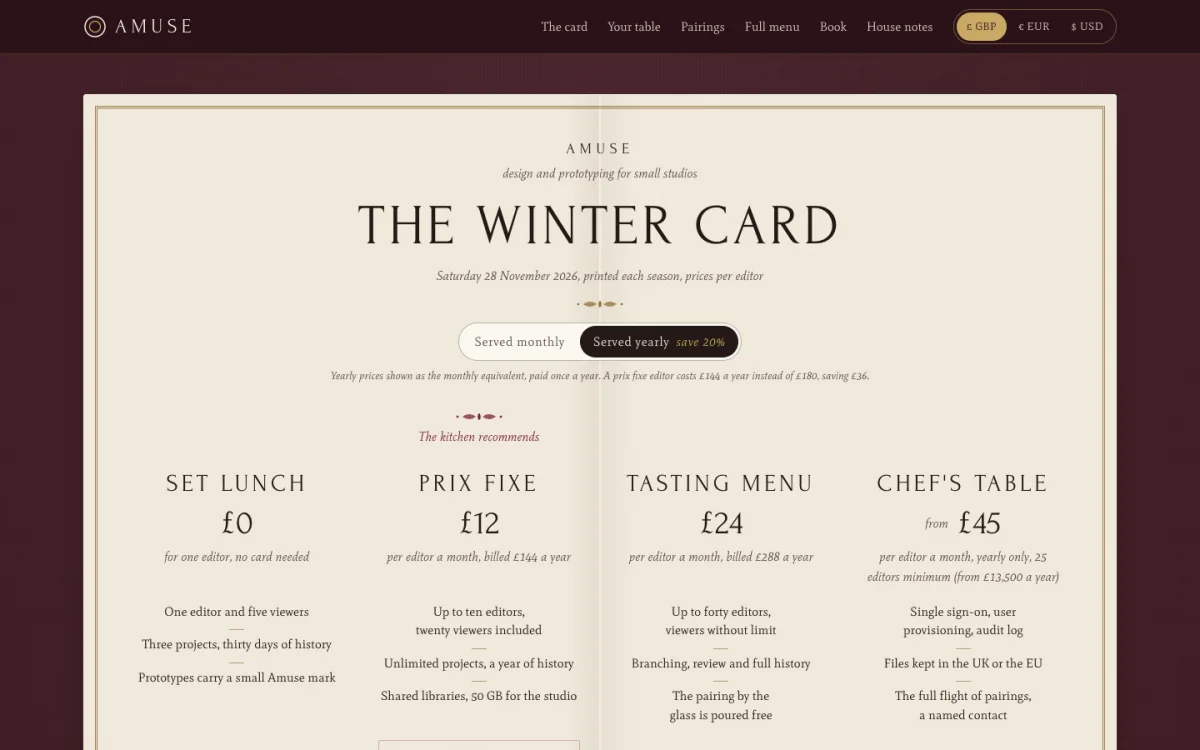
A fine-dining menu card on heavy cotton stock laid on a claret linen tablecloth: Forum course names carved in spaced capitals, Mate italic descriptions, gold foil fleurons and a double-rule frame, and a thin paper bill torn off the pad.
The first screen is the winter card itself: a folded menu on heavy cotton stock with a foil frame, printed on Saturday 28 November 2026. Its four courses are the four plans. The set lunch is free for one editor, the prix fixe is the course the kitchen recommends for two to ten editors (and the card says why), the tasting menu seats forty with unlimited viewers, and the chef's table is the enterprise plan, yearly only. A switch serves the card monthly or yearly and states the per-month equivalent, the annual total and the saving.
Set your table is the estimator. Editors and viewers are steppers, and each one is laid at a round table seen from above: editors get a chair, plate, cutlery and glass, viewers a glass. Sides are the add-ons (storage by the 100 GB, guest testing, client rooms, a font cellar), the pairing is integrations by the glass or the full flight, and single sign-on forces the chef's table. The bill prices every course for that table, picks the cheapest one that can seat it, shows each line, the yearly or monthly total and VAT in place of a service charge, and warns at the edges: viewer charges that make the tasting menu cheaper, the forty-editor limit, sixty viewers on the prix fixe.
Below, the wine list shows what each pairing pours, the full menu compares every limit per course (one course at a time on a phone), and Book the table takes the order from the bill into a validated checkout, a free sign-up for the set lunch or an enquiry for the chef's table, with loading, error and success states. House notes answer proration, refunds, cancelling, invoices, VAT, currency and discounts. Prices switch between pounds, euros and dollars at the stated rates of £1 = €1.17 and £1 = $1.27.
The brand is fictional: Amuse, a design and prototyping tool for small studios, made by Amuse Software Ltd in Ropewalk Yard, Bristol. Names, people and figures on the page are invented.
What works
- Currency switch (GBP, EUR, USD) in the header, arrow keys move it; every price on the page converts at the stated fixed rates
- Served monthly or yearly switch on the card: prices, per-month equivalent, annual total and saving all update, and the bill follows
- Editors and viewers steppers with typed input and specific range errors; place settings are laid around the drawn table
- Sides: storage servings stepper and three add-on ticks; pairing by radio; single sign-on tick; billed-to country sets VAT
- The bill: every line with its arithmetic, monthly and yearly totals, VAT, the saving against the other period, every course priced or crossed out with the reason, the cheapest marked, any course choosable
- Edge warnings: viewer charges tipping to the tasting menu, the ten and forty editor limits, sixty viewers, single sign-on, chef's table yearly only
- Order links on the card and pour buttons on the wine list set the table
- Full menu comparison with a one-course switcher on phones
- Booking: checkout, set lunch sign-up or chef's table enquiry from the bill, EU VAT number when needed, inline validation, loading, error with retry, success with reference
States you can link to
script.js reads these from the URL, so you can open the page in a given state to review it, screenshot it or show it to an agent.
| Parameter | What it does |
|---|---|
?billing=monthly | serves the card month to month. Open ?billing=monthly |
?currency=eur | every price in euros at £1 = €1.17 (also ?currency=usd). Open ?currency=eur |
?table=viewers | 4 editors and 40 viewers: the prix fixe's £60 viewer charge makes the tasting menu cheaper (£96 against £108 a month), and the bill says why. Open ?table=viewers |
?table=large | 48 editors, 120 viewers and the full flight: past the forty-editor limit, only the chef's table seats the table. Open ?table=large |
?state=invalid | submits the empty booking form and shows every validation message. Open ?state=invalid |
?state=loading | fills and submits the booking form and holds it in the loading state. Open ?state=loading |
?state=error | fills and submits, the booking does not go through; submitting again succeeds. Open ?state=error |
?state=success | fills and submits the booking form and shows the booked table with its reference. Open ?state=success |
?state=chef | 32 editors who need single sign-on: the bill moves to the chef's table and the form becomes the enquiry. Open ?state=chef |
Use it
Copy templates/menucard/ into your project, or download the zip, which has the Screenery badge script already removed. Colours, type, spacing and radii are custom properties at the top of style.css. This template loads no libraries: only its own files and web fonts.
The docs explain the token pattern and how to move a template into React, Vue, Svelte or Astro. The guide has prompts for handing it to a coding agent.