Prism
Fintech card landing page template · Software and web
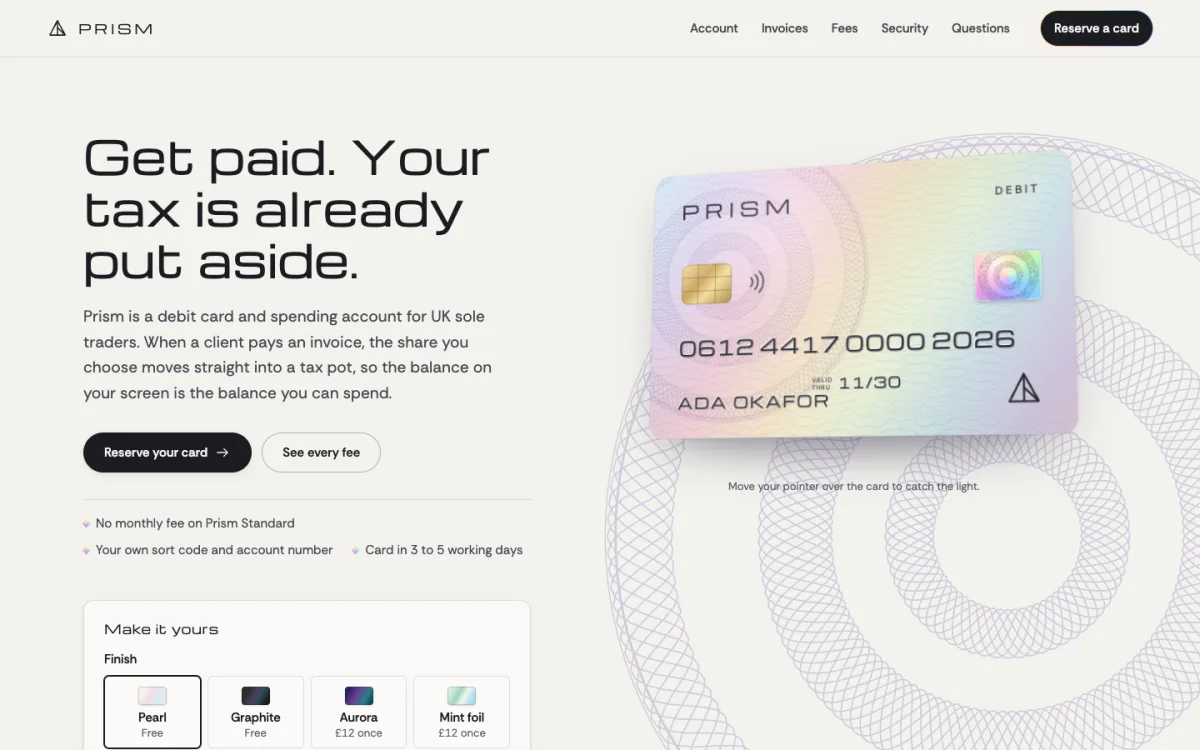
Security print and holographic foil: pearl cheque-book stock with guilloche line work, graphite ink, wide Michroma numerals and an oil-slick foil that only appears where light would catch it.
The first screen is the card. It tilts in 3D after the pointer, and the light moves with it: holographic foil bands slide across the face, a glitter of tiny points brightens where the glare falls, and a security hologram patch turns through the spectrum. On a phone a button offers to tilt with the device, asking for motion permission where the browser requires it. With reduced motion, without a hovering pointer or with ?tilt=off the card rests at a pleasing angle with the sheen held still. Beside it the customiser sets one of four finishes, Pearl, Graphite, Aurora and Mint foil, each with its own base, line work and blend of foil, and the name on the card, checked as you type: letters and spaces only, at most 21, printed in capitals and stepped down in size as an embosser would.
The spending account is a phone drawn in CSS. A slider chooses the share of every invoice that goes to the tax pot, and the phone's balances, each invoice's pot amount, an example split of a £2,400 invoice and a small ledger all follow it and always add up from the same opening balances. Invoices are shown as a printed document with a foil PAID seal, and the payment terms rebuild the reminder schedule. The fees table lists two plans plainly, and becomes stacked rows on a phone.
A graphite security section has a working freeze switch that frosts a mini card and a button that makes single-use card numbers. The sign-up asks for an email and four eligibility questions with specific inline messages for each answer that would stop or change the application, then shows loading, an error with retry, or a reserved card with a reference. Questions and a footer of clearly fictional regulatory small print with a line of security microtext close the page.
The brand is fictional: Prism, a fictional debit card and spending account for UK sole traders that sets aside a share of every invoice in a tax pot. Names, people and figures on the page are invented.
What works
- Card tilt: pointer over the stage leans the card and moves the foil, glitter, hologram and glare; drag on touch; settles back when the pointer leaves
- Tilt with your phone (touch devices only): device orientation after a tap, with permission handled and a message when denied or unavailable
- Finish chooser: four finishes restyle every card on the page and update the URL
- Name on card: live preview in capitals, character count, specific errors for numbers, symbols, double spaces and names over 21 characters
- Tax pot slider (0 to 50%): phone balances, per-invoice pot amounts, split bar and ledger recalculate
- Invoice payment terms (7, 14, 30 days): due date and reminder schedule rebuild
- Freeze switch with status and time; single-use number generator that refuses while frozen
- Sign-up: inline validation, eligibility messages, loading, error with retry, success with reference; reserve another
- Questions accordion
States you can link to
script.js reads these from the URL, so you can open the page in a given state to review it, screenshot it or show it to an agent.
| Parameter | What it does |
|---|---|
?finish=graphite | opens with the Graphite card (also pearl, aurora, mint). Open ?finish=graphite |
?name=SAM%20RIVERA | prints a different name on every card and greets them in the app. Open ?name=SAM%20RIVERA |
?tilt=off | the card rests at its still angle with the sheen held, pointer ignored. Open ?tilt=off |
?pot=30 | sets the tax pot share (0 to 50) and recalculates the phone and ledger. Open ?pot=30 |
?state=success | fills the sign-up, submits and shows the reserved card with reference PRM-7Q4K. Open ?state=success |
?state=error | fills and submits, the server cannot be reached; sending again succeeds. Open ?state=error |
Use it
Copy templates/holocard/ into your project, or download the zip, which has the Screenery badge script already removed. Colours, type, spacing and radii are custom properties at the top of style.css. This template loads no libraries: only its own files and web fonts.
The docs explain the token pattern and how to move a template into React, Vue, Svelte or Astro. The guide has prompts for handing it to a coding agent.
Inspection
Loaded in Chromium 156.0.8078.4 (Playwright, headless) on 27 November 2026 at 1440, 1024, 768, 390 pixels wide and once more with reduced motion requested. Every check passed at every width.
- 1440 px
- Pass
- 1024 px
- Pass
- 768 px
- Pass
- 390 px
- Pass
- Reduced motion
- Pass
- Page weight
- 170 KB, 7 requests
Requests and transferred size were measured at 1440 pixels on a cold cache and include web fonts and any CDN library. The full result is in the viewer: open the Checks panel. How templates are checked.