Six Yards
Money transfer app page template · App screens
A length of West African wax-print cloth: an indigo ground printed with bold repeat motifs, cream crackle veins, a second colour laid a little off register, and a selvedge edge printed with the maker's name.
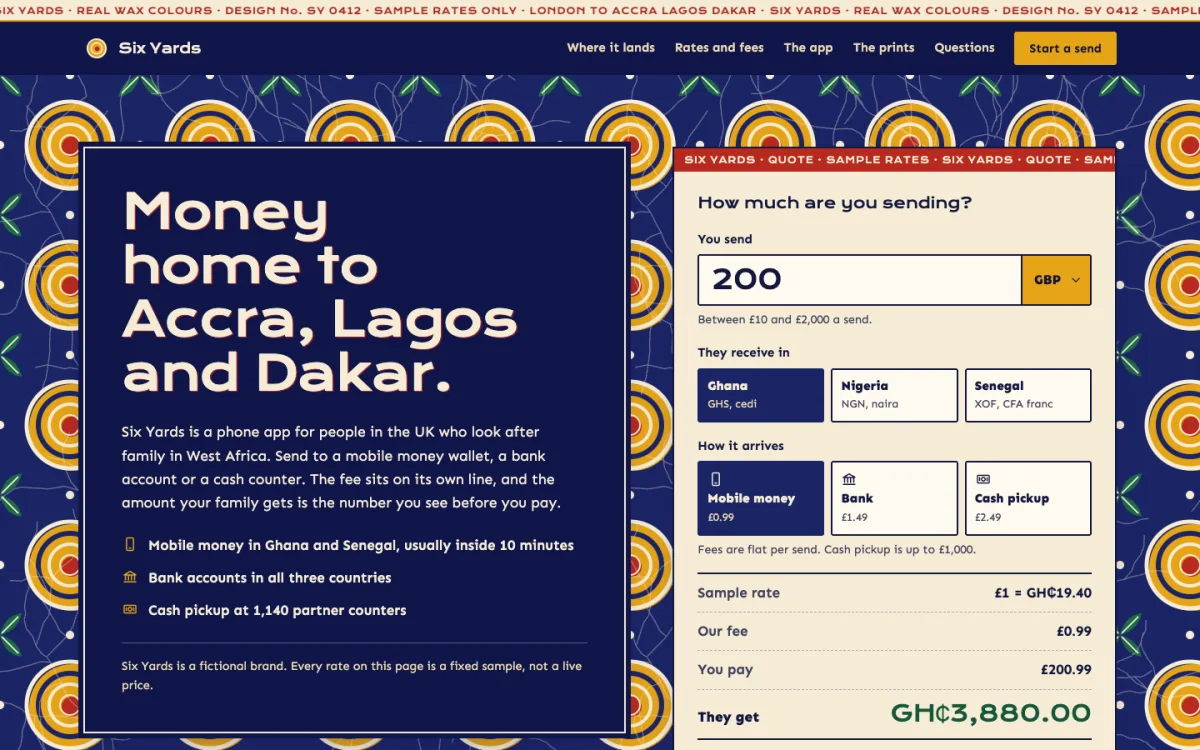
The page is a length of wax-print cloth. The header is the selvedge, the printed edge where a real cloth carries its maker's name and design number, and here it reads Six Yards, Design No. SY 0412. The hero ground is the app's own print, Ten Minutes: ripples from a dropped coin in gold, cream and red on indigo, with thin crackle veins where the wax cracked and the red laid slightly off register under the headline, as it is on printed cloth.
On that ground sits the calculator, a cream wax label. Type an amount in pounds or euros, pick Ghana, Nigeria or Senegal and mobile money, bank or cash pickup; it shows the fixed sample rate, the flat fee on its own line, what you pay, what they get, rounded down to the currency's smallest unit, and an arrival estimate worked out from the clock in the recipient's own city. Nigeria has no mobile money, cash pickup caps at £1,000, and the limits explain themselves. The send flow below takes the recipient's details with per-country rules for phone and account numbers, a review with a confirmation tick, a sending state, a network error that takes nothing, and a receipt edged with the selvedge and the Sunday Rice print.
Then where money lands and how long it takes in each country, every sample rate and fee in two tables with one send worked out on a slip, the app drawn in CSS tracking a send to the wallet, a short honest note on where wax print comes from beside the app's four own prints, the questions people ask before a first send, and a footer that says plainly the company and its rates are fictional. Everything is drawn in SVG and CSS. There are no photographs and no libraries.
The brand is fictional: Six Yards, a fictional app on Rye Lane in Peckham for sending money from the UK to family in Ghana, Nigeria and Senegal. Names, people and figures on the page are invented.
What works
- Transfer calculator: amount, GBP or EUR, receiving country, delivery method; fee, total, amount received and arrival estimate update live
- Method availability per country (no mobile money for Nigeria) and limits per method, with specific messages
- Recipient form that changes its fields by method: mobile number with country prefix, bank and account number, or pickup town
- Inline validation per country: digit counts, leading 0, full name as on ID, reason for sending
- Review step with a confirmation tick, then sending, network error with retry, and a receipt with a reference
- Copy the reference; send another resets the flow
- Questions accordion
States you can link to
script.js reads these from the URL, so you can open the page in a given state to review it, screenshot it or show it to an agent.
| Parameter | What it does |
|---|---|
?to=ng | Nigeria selected: mobile money struck through, bank chosen. Open ?to=ng |
?to=sn&method=cash | Senegal by cash pickup, amounts in whole CFA francs. Open ?to=sn&method=cash |
?amount=500 | presets the amount (any number); ?amount=1500&method=cash shows the cash pickup limit message. Open ?amount=500 |
?from=eur | sends from euros with the euro fees and limits. Open ?from=eur |
?time=16:40 | sets the UK clock (any HH:MM) so arrival estimates roll to the next working day. Open ?time=16:40 |
?state=recipient | opens at the recipient step. Open ?state=recipient |
?state=invalid | recipient step submitted with mistakes, showing inline errors. Open ?state=invalid |
?state=review | a filled-in demo send on the review step. Open ?state=review |
?state=sending | the sending state with the spool. Open ?state=sending |
?state=error | the send fails at the network and nothing is taken. Open ?state=error |
?state=success | the send goes through and shows the receipt. Open ?state=success |
Use it
Copy templates/waxprint/ into your project, or download the zip, which has the Screenery badge script already removed. Colours, type, spacing and radii are custom properties at the top of style.css. This template loads no libraries: only its own files and web fonts.
The docs explain the token pattern and how to move a template into React, Vue, Svelte or Astro. The guide has prompts for handing it to a coding agent.