Bestia Paint
Paint colour matcher and room planner template · Shops and makers
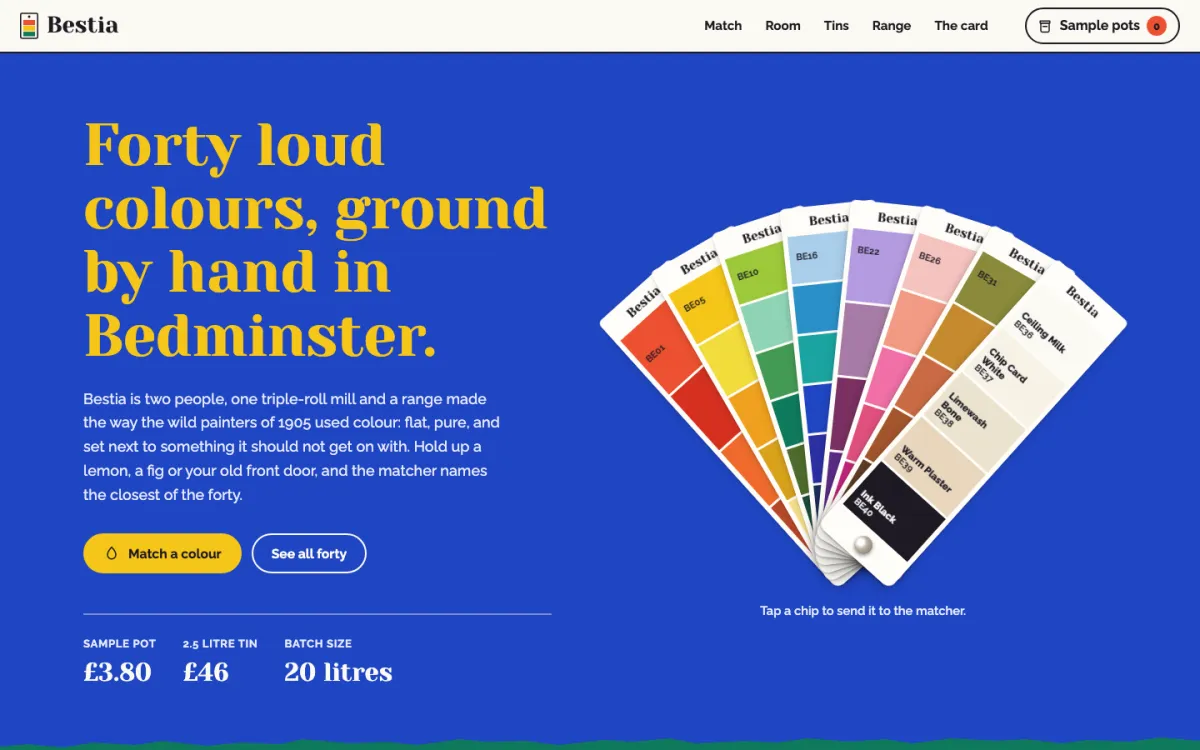
A small paint maker's own chip cards and riveted fan deck, set on flat Fauvist blocks of cobalt, viridian, oleander, chrome yellow, violet and vermilion, where every colour sits next to one it should not get on with.
The first screen is the maker's fan deck: eight riveted strips holding all forty colours, opening across a cobalt ground. Like a real deck, only the codes on each strip's edge show until you lift a strip; tap any chip and it goes to the matcher. Every section below is a flat block in one of the range's own colours, with the tools set on white punched chip cards.
The matcher takes a colour from the picker, a typed hex code or one of six drawn objects on the bench (a lemon, a terracotta pot, a fig, a sea glass bottle, a tomato tin, an enamel mug), measures the CIEDE2000 distance to every chip and lists the five nearest with the target and chip side by side. It then pairs the best match with a Fauve neighbour from the far side of the colour wheel, a trim chosen for contrast and a pale ceiling, and can paint all four into the drawn front room, where walls, chimney breast, trim and ceiling can also be repainted one by one from the full range.
The tin calculator takes any number of walls, doors, windows, coats and a finish's coverage, shows the arithmetic line by line and picks the cheapest mix of 2.5 litre and 1 litre tins, optionally with the ceiling. Below are the full range with family filters, the back of the card with finishes, sizes, prices and house rules, the sample pot basket with free postage from five pots, the order form with inline validation, loading, error and success states, the counter questions and the footer.
The brand is fictional: Bestia Paint, a two-person paint maker grinding forty flat matt and eggshell colours in a back room on North Street, Bedminster, Bristol. Names, people and figures on the page are invented.
What works
- Fan deck: lift a strip on hover or focus to read its names; tap a chip to match it
- Matcher: colour picker, hex field with validation, six drawn sample objects; five nearest chips with CIEDE2000 distance and a verdict
- Pairings: walls, Fauve neighbour, trim and ceiling computed from the best match; paint the room with them in one click
- Room: choose walls, chimney breast, trim or ceiling and repaint it from all forty chips; reset to bare plaster; add the four as pots
- Tin calculator: add and remove walls, door and window steppers, coats, finish, ceiling option; live arithmetic and cheapest tin mix
- Range: filter by family; match or add a pot from any chip
- Sample pots: add, remove, starter set, eight-pot limit, free postage from five, collect option
- Order form: inline validation (UK postcode, email), loading, error and success with an order number
States you can link to
script.js reads these from the URL, so you can open the page in a given state to review it, screenshot it or show it to an agent.
| Parameter | What it does |
|---|---|
?match=%23c96a44 | matches any hex colour on load. Open ?match=%23c96a44 |
?sample=fig | selects a bench object (lemon, pot, fig, glass, tin, mug). Open ?sample=fig |
?chip=BE19 | matches a chip from the range by code. Open ?chip=BE19 |
?family=pinks | filters the range to one family. Open ?family=pinks |
?pots=demo | a basket with five sample pots and free postage. Open ?pots=demo |
?state=empty | the empty basket with the starter set offer. Open ?state=empty |
?state=success | places a demo order and shows the stamped confirmation. Open ?state=success |
?state=error | places a demo order and shows the failed-to-reach-the-order-book state. Open ?state=error |
Use it
Copy templates/paintchip/ into your project, or download the zip, which has the Screenery badge script already removed. Colours, type, spacing and radii are custom properties at the top of style.css. This template loads no libraries: only its own files and web fonts.
The docs explain the token pattern and how to move a template into React, Vue, Svelte or Astro. The guide has prompts for handing it to a coding agent.