Pennock
Single-speed bicycle product page template · Shops and makers
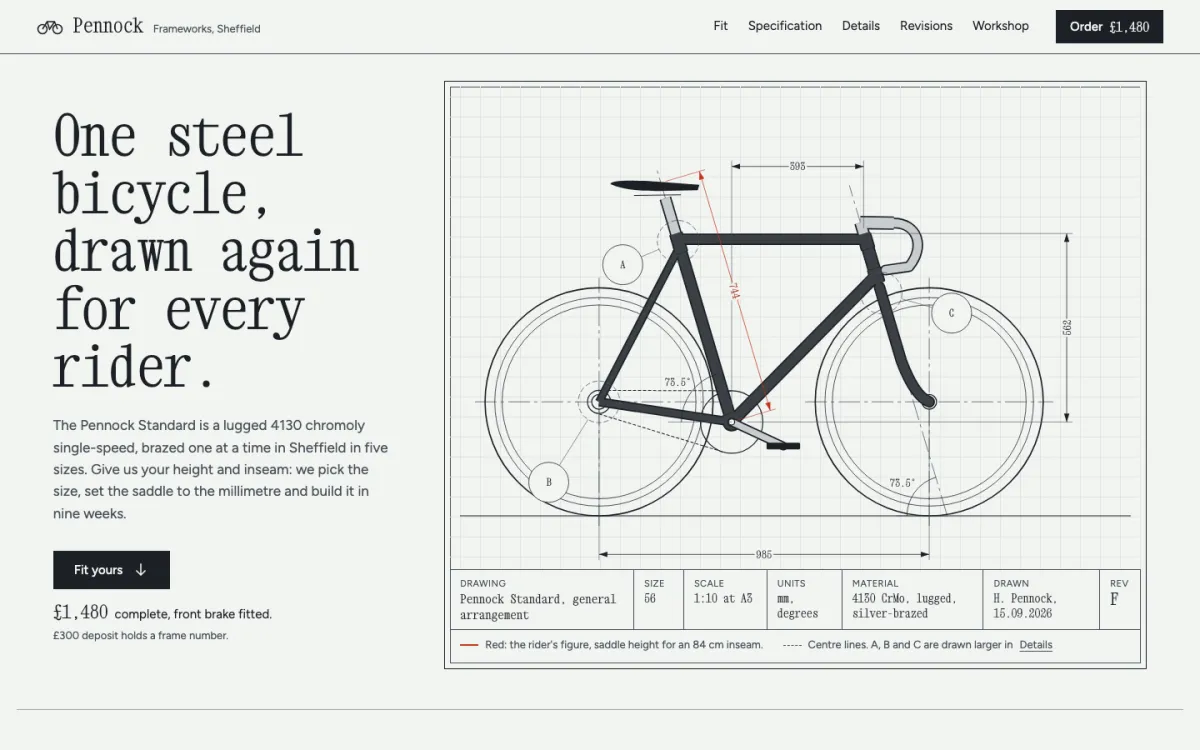
A frame builder's drafting sheet: drafting white with a faint grid, graphite line work in two weights, dash-dot centre lines, dimension lines with filled arrowheads, angle arcs and a title block, with drafting red kept for the rider's own figures.
The page is the builder's drawing. The first screen is the general arrangement of the Pennock Standard: wheels, lugged frame, fork, drop bar and saddle in graphite line work, centre lines through the axles and the steering axis, dimensioned stack, reach, wheelbase, head and seat angles, callout circles for the three detail views and a title block with scale, material and revision. The saddle height is the one dimension in red, because it is the rider's.
At the centre is the fit and build tool. Height and inseam pick a size by a stated rule and set the saddle height; size, chainring, cog, bar and paint redraw the elevation at the same scale, so a 60 visibly outgrows a 52. Alongside it the page works out stack, reach, how much seatpost shows, gear inches, metres per crank turn, speed at 90 rpm and skid patches, itemises the price, and marks the chosen column in a geometry chart computed for all five sizes. The order and fitting flow takes that build into a deposit order or a Saturday fitting with inline validation, loading, a failed-payment state and an issued stamp.
Below are the specification and a parts list whose prices and weights add up to the bicycle, three detail views at 1:2, the revision table from 2019 to today with the frames built to each letter, the queue on the jig, the workshop and the questions people ask. Everything is drawn in SVG and CSS; there are no photographs.
The brand is fictional: Pennock Frameworks, a one-bicycle frame builder in Sheffield that brazes a lugged 4130 chromoly single-speed in five sizes. Names, people and figures on the page are invented.
What works
- Height and inseam inputs with validation pick a size and saddle height, with the arithmetic shown
- Size, chainring, cog, bar and paint redraw the SVG bicycle at true relative scale
- Live readouts: stack, reach, saddle height, seatpost showing with a warning, gear inches, development, speed, skid patches
- Itemised price that follows paint and bar choices
- Geometry chart for all five sizes with the chosen size marked
- Order or fitting tabs, Saturday slot picker with taken slots, delivery choice that updates the order sheet
- Inline validation, loading, payment error with retry, issued stamp, start again
- Copy the workshop address; questions accordion
States you can link to
script.js reads these from the URL, so you can open the page in a given state to review it, screenshot it or show it to an agent.
| Parameter | What it does |
|---|---|
?fit=short | a 163 cm rider with a 77 cm inseam: size 52. Open ?fit=short |
?fit=tall | a 196 cm rider with a 94 cm inseam: size 60. Open ?fit=tall |
?fit=outside | a 64 cm inseam, below the smallest size, with the fitting suggestion. Open ?fit=outside |
?size=60&ring=48&cog=15&bar=bullhorn&paint=oxide | any build set from the URL (size, ring, cog, bar, paint). Open ?size=60&ring=48&cog=15&bar=bullhorn&paint=oxide |
?state=invalid-fit | the fit tool with the inseam missing. Open ?state=invalid-fit |
?state=invalid | the order form with every validation message showing. Open ?state=invalid |
?state=fitting | the fitting booking tab with Saturday slots. Open ?state=fitting |
?state=loading | a filled order while the payment is being sent. Open ?state=loading |
?state=error | the failed card payment with a retry. Open ?state=error |
?state=success | the issued order stamp for frame 227. Open ?state=success |
Use it
Copy templates/fixie/ into your project, or download the zip, which has the Screenery badge script already removed. Colours, type, spacing and radii are custom properties at the top of style.css. This template loads no libraries: only its own files and web fonts.
The docs explain the token pattern and how to move a template into React, Vue, Svelte or Astro. The guide has prompts for handing it to a coding agent.